Introduction: You Don’t Need Thousands of Dollars to Get Started
Many people assume buying stocks requires a large lump sum, a finance degree, or a stockbroker on speed dial. None of that is true anymore. Thanks to fractional shares and zero-commission trading, you can now own a slice of a company like Amazon, Microsoft, or Apple for as little as $1 without paying a dime in trading fees.
This guide walks through exactly how to buy your first stock, step by step, including the account types available, how order types work, what fractional shares actually mean for your wallet, and the costs and mistakes to watch out for along the way.
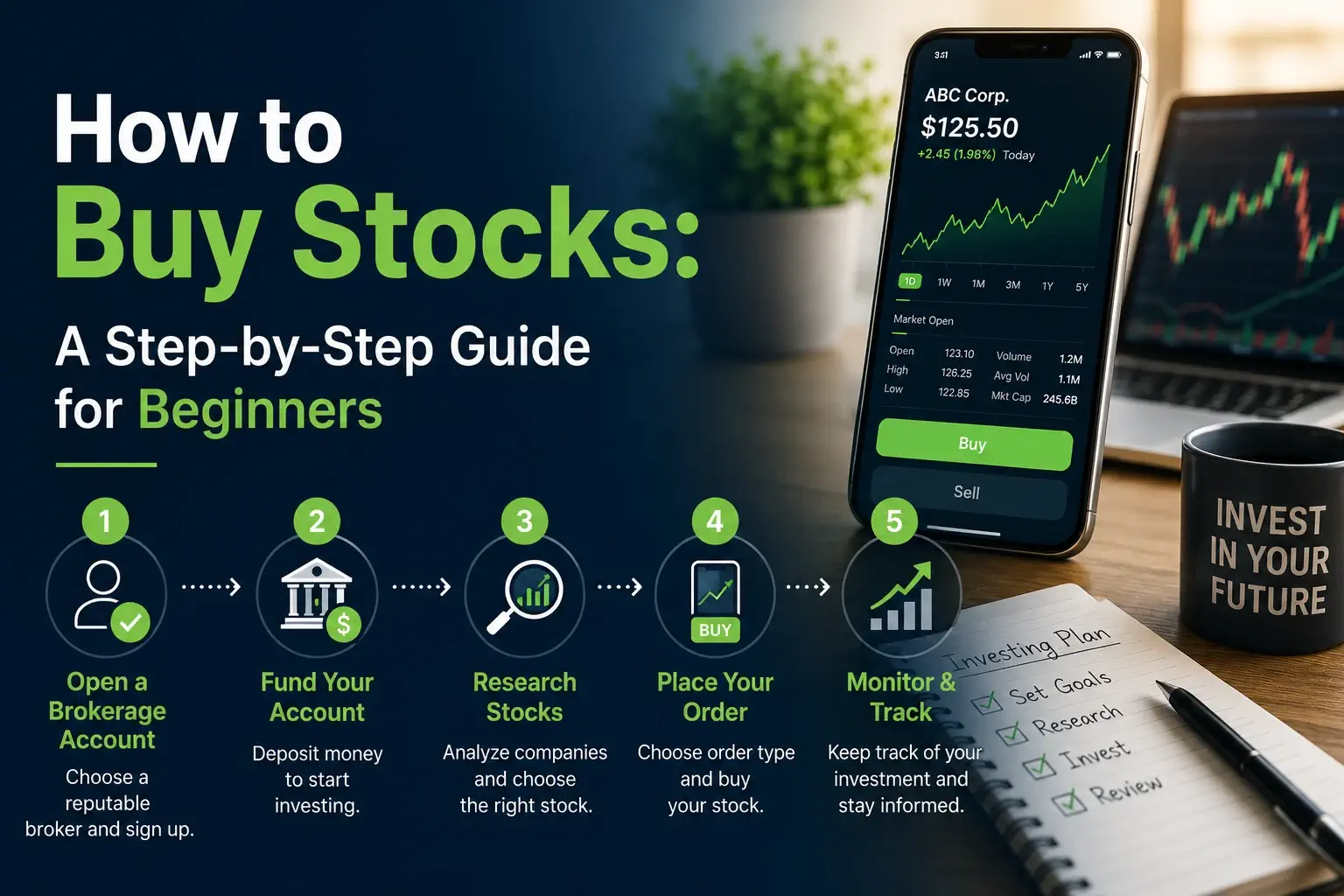
Step 1: Open a Brokerage Account
Before you can buy a single share, you need a brokerage account the platform that connects you to the stock market. Most major online brokers now offer accounts with no minimum balance requirement and no commission on stock or ETF trades.
Types of Brokerage Accounts to Consider
- Standard taxable brokerage account: the most flexible option, with no contribution limits or withdrawal restrictions, but no special tax advantages.
- Roth IRA contributions are made with after-tax dollars, and qualified withdrawals in retirement are tax-free, making it ideal for long-term growth.
- Traditional IRA contributions may be tax-deductible now, with withdrawals taxed in retirement.
- Employer-sponsored 401(k) is typically limited to funds chosen by your employer’s plan, but often includes a valuable employer match.
When comparing brokers, most platforms today share similar core features: commission-free stock, options, and ETF trades have become standard across the industry, with account minimums largely disappearing for self-directed investing.
What to Look For When Choosing a Broker
- No account minimum or low minimum to start
- Commission-free stock and ETF trades
- Fractional share availability
- Quality research and educational tools for beginners
- A mobile app and platform that feels intuitive to you
Step 2: Fund Your Account
Once your account is open, you’ll need to link a bank account and transfer funds. Most transfers take one to three business days to clear, though some brokers offer instant access to a portion of deposited funds for trading purposes.
A practical tip for beginners: only transfer money you won’t need for daily expenses or emergencies. Stock prices fluctuate, and you don’t want to be forced to sell at a loss because you need the cash for something else.
Step 3: Research the Stock You Want to Buy
Before placing an order, take time to understand what you’re buying. At minimum, review:
- The company’s business model: how does it actually make money?
- Recent financial performance: revenue growth, profitability, and debt levels
- Is the valuation reasonable relative to its earnings and growth prospects?
- Sector and competitive position: how does it compare to peers in its industry?
If individual stock research feels overwhelming at first, many beginners start with a diversified index fund or ETF that tracks a broad market benchmark like the S&P 500, rather than picking individual companies right away.
Step 4: Decide How Many Shares to Buy
This is where fractional shares have changed the game for new investors. Historically, if a stock traded at $400 per share, you needed $400 to buy just one share. Today, fractional share investing allows you to purchase small slices of a stock rather than a full share, and most major brokers now support this feature with no added commission.
Some real examples of how accessible this has become:
- Interactive Brokers allows fractional share purchases starting at just $1 across a wide range of eligible U.S. and international stocks.
- Charles Schwab’s fractional share offering, branded “Stock Slices,” lets investors buy from up to 30 S&P 500 companies at once for as little as $5 each.
- SoFi’s Active Investing platform supports fractional-share trading on more than 4,700 stocks and ETFs.
This means a $50 monthly contribution can be split across several companies, rather than being limited to whichever single stock happens to cost less than $50 per share.
Step 5: Choose an Order Type
When you’re ready to buy, you’ll typically choose between two main order types:
- A market order executes immediately at the current market price. Best for buying right away without concern over small price fluctuations.
- A limit order only executes at a price you specify or better. Useful if you want more control over your entry price, though the order may not fill if the stock never reaches your target price.
For most long-term, buy-and-hold investors, a simple market order is sufficient; the difference of a few cents per share rarely matters over a multi-year holding period.
Step 6: Place the Order and Monitor Your Investment
Once you’ve selected the stock, entered the dollar amount or number of shares, and chosen your order type, you’ll review and confirm the trade. After execution, the shares (or fractional shares) will appear in your portfolio, typically within seconds for market orders during trading hours.
From there, the most important habit isn’t checking the price daily; it’s reviewing your holdings periodically (quarterly or annually) to ensure your portfolio still aligns with your goals, rather than reacting to short-term price swings.
Costs to Watch For When Buying Stocks
While headline “commission-free” trading has become the industry standard, a few costs can still apply:
- Fund expense ratios and annual fees built into ETFs and mutual funds; low-cost S&P 500 index funds can carry expense ratios as low as 0.015 percent annually, while actively managed funds often charge considerably more.
- Options and broker-assisted trade fees: these typically don’t apply to simple stock purchases but can apply to more advanced order types.
- Account transfer fees charged by some brokers if you move your account to a competitor.
- Currency conversion fees relevant only if trading international stocks through certain platforms.
Always review a broker’s fee schedule before opening an account, even when “commission-free” is the headline feature.
Common Mistakes Beginners Make When Buying Stocks
- Buying without a plan: purchasing a stock because of hype or a social media trend, without understanding the underlying business.
- Putting all your money into one stock: concentrating risk in a single company rather than diversifying across multiple holdings or a fund.
- Checking prices obsessively: daily price-watching often leads to emotional decisions that undermine a long-term strategy.
- Ignoring fees on funds: a seemingly small 1% annual expense ratio can meaningfully erode returns when compounded over decades.
- Investing money needed for short-term expenses: stock prices can decline sharply in the short term, so only invest money you can leave untouched for several years.
Conclusion: Your First Trade Is Just the Beginning
Buying your first stock is no longer the complicated, capital-intensive process it once was. Between zero-commission trading and fractional shares starting at $1, the practical barriers to entry have largely disappeared; what matters now is approaching each purchase with research, patience, and a long-term mindset rather than short-term speculation.
Ready to buy your first stock? Open a brokerage account if you haven’t already, decide on a fixed dollar amount you’re comfortable investing, and research one company or index fund that fits your goals before placing your first trade.