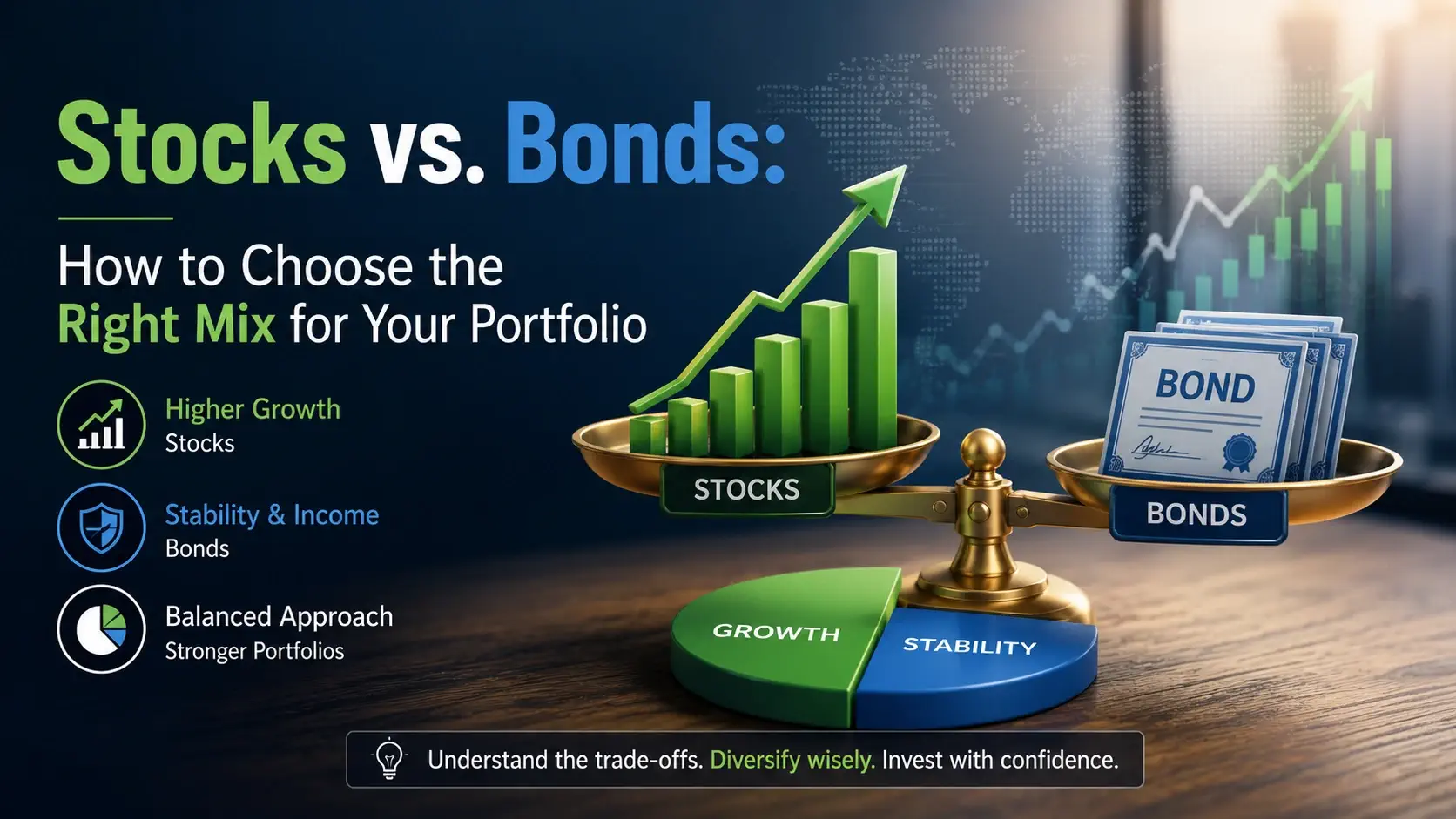
Introduction: Two Assets, One Critical Trade-Off
Why does nearly every financial advisor recommend holding both stocks and bonds, even though one consistently outperforms the other over the long run? The answer lies in a simple but powerful trade-off: growth versus stability. Understanding how stocks and bonds differ and how they behave together is one of the most important steps toward building a portfolio that can weather market volatility while still growing your wealth over time.
This guide breaks down exactly what separates stocks from bonds, how each has historically performed, and how to think about blending the two based on your goals and risk tolerance.
What Are Stocks?
A stock represents partial ownership in a company. When you buy shares, you become a shareholder with a claim on the company’s future profits and growth. Stock value rises and falls based on company performance, investor sentiment, and broader economic conditions, which makes stocks the more volatile but historically higher-returning of the two asset classes.
What Are Bonds?
A bond is essentially a loan. When you buy a bond, you’re lending money to a government or corporation in exchange for regular interest payments and the return of your principal at maturity. Unlike stocks, which are issued by corporations seeking equity investment, bond issuers can be governments such as the U.S. Treasury or companies raising debt capital. Because bondholders are creditors rather than owners, bonds generally carry lower risk and lower long-term return potential than stocks.
Stocks vs. Bonds: Historical Performance
The Long-Term Numbers
Looking back nearly a century of market data offers the clearest picture of how these two asset classes actually compare:
- From 1928 to 2025, the S&P 500 delivered an average annual return of approximately 10.02 percent including dividends.
- Over the same period, Baa-rated corporate bonds averaged a 6.62 percent annual return, meaningfully lower, but with significantly less volatility.
- A more recent comparison tells a similar story: between 1997 and 2024, the S&P 500 returned 9.7 percent annually on average, while the U.S. Aggregate Bond Index returned just 4.1 percent.
How Often Does Each Asset Actually Win?
Averages only tell part of the story; consistency matters too. Over any given 10-year period, stocks have outperformed bonds roughly 89 percent of the time, and over 15- and 20-year periods, stocks have beaten bonds in every single instance on record. On a year-by-year basis, stocks have posted positive annual price returns approximately 75 percent of the time historically.
Bonds, meanwhile, win on a different metric entirely: consistency of safety. The bond market has only posted a calendar-year loss roughly 10 percent of the time since 1980, making it a far more dependable source of capital preservation, even if the upside is smaller.
When Bonds Outperform
Stocks don’t win every single year. During the early 2000s, bonds actually delivered better returns than stocks over several consecutive years, reinforcing why a purely stock-heavy strategy isn’t automatically the right choice for every investor or every market cycle.
Why Stocks Are Riskier But Built for Growth
The core reason stocks command a higher average return is the risk premium investors demand for tolerating volatility. Stock prices can swing dramatically within a single year based on earnings reports, interest rate changes, geopolitical events, or shifting investor sentiment. This volatility cuts both ways: it creates the potential for outsized gains, but also the risk of significant short-term losses.
For investors with a long time horizon, typically 10+ years, this volatility tends to smooth out, which is why younger investors saving for retirement decades away are often encouraged to hold a higher percentage of stocks.
Why Bonds Provide Stability
Bonds behave differently because they pay a fixed, contractual interest rate and return your principal at a set maturity date (assuming the issuer doesn’t default). This predictability is exactly why bonds are favored by:
- Investors nearing or in retirement who need reliable income
- Anyone with a shorter time horizon who can’t afford a market downturn right before they need the money
- Portfolios seeking to reduce overall volatility through diversification
Bonds and stocks also tend to respond in opposite directions during market stress. When stocks decline sharply, investors often move money into the relative safety of bonds, pushing bond prices up and yields down, which is part of why combining the two can reduce a portfolio’s overall volatility.
The Exception That Proves the Rule: 2022
Diversification isn’t foolproof. In 2022, both asset classes declined simultaneously; the S&P 500 lost 18.0 percent while Baa corporate bonds fell 15.1 percent, driven by the fastest pace of Federal Reserve interest rate hikes in decades. It was a rare reminder that while stocks and bonds usually move independently or even in opposite directions, no diversification strategy eliminates risk.
Current Bond Market Conditions in 2026
For context on where bond yields stand today: the 10-year U.S. Treasury yield was trading at approximately 4.38 percent as of late June 2026. Elevated yields relative to the post-2008 era mean newly issued bonds currently offer more attractive income than they did during the previous decade of near-zero interest rates a meaningful shift for income-focused investors.
Blended Portfolios: Getting the Best of Both
Most professional portfolio strategies don’t ask “stocks or bonds”; they ask “what ratio of stocks to bonds.” Historical data on blended allocations illustrates the trade-off clearly:
- A 100% stock portfolio has historically returned around 10.3% annually, with the highest volatility including annual losses as steep as -43% in the worst years.
- A 60/40 stock-bond portfolio has delivered a long-term average of 8.66 percent annually, tempering volatility while preserving meaningful growth.
- A 100% bond portfolio has historically averaged around 5.3% annually, with far smaller swings in either direction.
The right blend ultimately depends on three personal factors: your investment time horizon, your tolerance for short-term losses, and your specific financial goals.
How to Decide Your Stocks-to-Bonds Ratio
- Long time horizon (10+ years): a higher stock allocation generally makes sense, since there’s time to recover from downturns.
- Shorter time horizon (under 5 years): a higher bond allocation reduces the risk of needing to sell stocks during a downturn.
- Lower risk tolerance: even younger investors uncomfortable with large swings may prefer a more balanced mix.
- Income needs: Retirees or those needing predictable cash flow often shift toward a higher bond allocation as they age.
A commonly cited (though not universal) rule of thumb suggests subtracting your age from 110 or 120 to estimate an appropriate stock percentage, though this should be adjusted based on individual risk tolerance and goals rather than applied rigidly.
Conclusion: It’s Not Stocks vs. Bonds; It’s Stocks and Bonds
The stocks-versus-bonds debate isn’t really about picking a winner over the long run; stocks have already won that contest, delivering meaningfully higher average returns than bonds across nearly every extended time horizon. The real value of bonds lies in what they contribute to a portfolio beyond raw returns: stability, income, and a cushion during the inevitable periods when stocks decline sharply.
Building the right mix comes down to matching your asset allocation to your personal time horizon and risk tolerance, not chasing whichever asset performed best last year.
Ready to evaluate your own allocation? Review your current portfolio’s stock-to-bond ratio against your investment timeline and risk tolerance, and consider whether a rebalance is overdue, especially if you haven’t adjusted your mix in the past 12 months.