Introduction: The Word That Changes Everything
No single word shifts economic sentiment faster than “recession.” Politicians pivot their messaging around it. Central banks adjust policy in response to it. Businesses freeze hiring because of it. And millions of households — whether they know it or not — feel its effects in the form of layoffs, tightened credit, falling home values, and declining retirement account balances.
Yet despite how frequently the word appears in financial headlines, a majority of Americans have only a surface-level understanding of what a recession actually is, what causes one, how long it typically lasts, and — most critically — what they can do right now to protect their financial position if one arrives.
As of mid-2026, most economic data and market signals point away from an imminent U.S. recession — however, consensus probability estimates among major forecasters cluster in the 15–35 percent range, with some outlier bearish models pushing materially higher if specific shocks occur. That range of uncertainty is exactly why understanding recessions — not just reacting to them — is one of the most valuable things any financially aware person can do.
What Is a Recession? The Official Definition
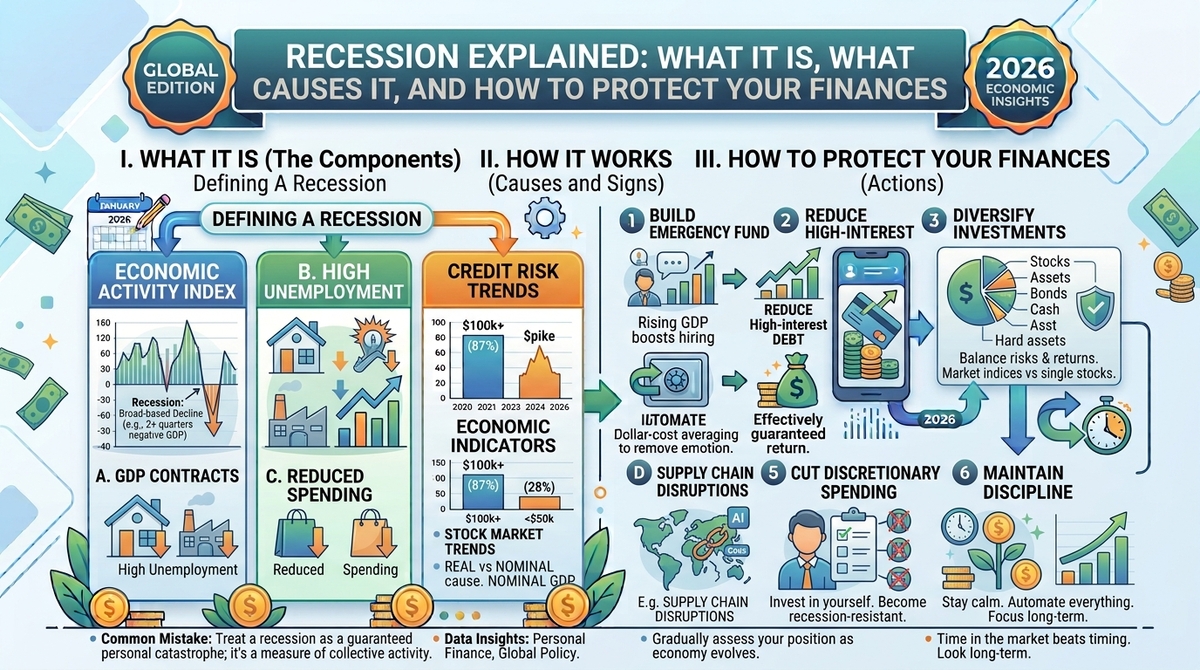
A recession is a significant, widespread, and sustained decline in economic activity across an economy. In popular usage, the most cited definition is two consecutive quarters of negative real GDP growth — meaning the economy shrinks for at least six months in a row. This threshold is simple, widely understood, and often referenced in financial media.
However, the official U.S. arbiter of recession dating is the National Bureau of Economic Research (NBER), a non-partisan research organization that takes a broader and more nuanced view. The U.S. has experienced 13 recessions since World War II, with the most recent being from February 2020 to April 2020 — the shortest recession on record, lasting just two months but also producing the highest unemployment rate since the Great Depression.
The NBER defines a recession not simply by two quarters of negative GDP, but by a significant decline in economic activity that is spread across the economy and lasts more than a few months, as reflected in indicators including:
- Real GDP — the total output of goods and services adjusted for inflation
- Real income — household earnings after accounting for price changes
- Employment — the level of hiring and job creation or destruction
- Industrial production — the output of manufacturing, mining, and utilities
- Retail sales and consumer spending — the volume of household purchases
This broader definition means a recession can sometimes be declared even without two full consecutive quarters of negative GDP — and conversely, two quarters of mild contraction may not meet the NBER’s threshold if other indicators remain resilient.
What Causes a Recession?
Recessions do not emerge from a single cause. They are typically the result of one or more economic shocks interacting with underlying vulnerabilities in household balance sheets, business conditions, or the financial system. The most common triggers include:
Demand Shocks
When consumer and business spending falls sharply — either because of rising prices, falling confidence, or tightened credit — the economy can lose the momentum needed to sustain growth. Consumer spending accounts for roughly two-thirds of U.S. GDP, which means any sustained pullback in household consumption has outsized economic consequences.
Supply Shocks
Sudden disruptions to the supply of critical goods — particularly energy — can simultaneously push prices up and economic output down, creating the particularly damaging combination known as stagflation. The recession beginning in late 1973 was triggered by a sharp rise in oil prices, which led to rising inflation and a peak unemployment rate of 8.6 percent.
Financial System Stress
When credit markets seize up — as they did dramatically in 2008 — businesses and households lose access to the borrowing they rely on to invest, hire, and spend. The Great Recession was the longest recession since World War II, during which real GDP fell 8.5 percent in the fourth quarter of 2008 alone, and unemployment reached 10 percent by October 2009.
Asset Bubble Collapses
When the prices of assets — homes, stocks, or other financial instruments — rise far beyond their fundamental value and then collapse, the resulting destruction of household and institutional wealth can trigger a sharp economic contraction.
External Shocks
Pandemics, wars, natural disasters, and geopolitical disruptions can produce sudden, severe economic contractions. The shortest recession on record lasted just two months, from February to April 2020, at the onset of the COVID-19 pandemic — though its depth was extraordinary, with unemployment surging to 14.8 percent at its April 2020 peak.
Monetary Policy Tightening
When the Federal Reserve raises interest rates aggressively to combat inflation, the resulting increase in borrowing costs can slow economic activity enough to tip the economy into recession. The early 1980s recession — one of the harshest of the post-war period — lasted 18 months, peak to trough. At its height in the first quarter of 1982, real GDP fell by 6.1 percent, and by December 1982, unemployment had risen to 10.8 percent, the highest since the Great Depression.
How Long Do Recessions Last?
The duration of a recession varies significantly depending on its cause, depth, and the policy response. Historical data offers a useful baseline.
The average recession lasts approximately 10 months, while the average economic expansion lasts over five years. This asymmetry is important: while recessions are painful, they are typically far shorter than the expansions that precede and follow them. The U.S. economy has historically recovered from every recession in its history — though the speed and character of those recoveries have varied considerably.
Key historical reference points:
- The COVID-19 recession (2020) lasted just two months — the shortest on record — but produced the deepest single-quarter GDP decline since WWII
- The Great Recession (2007–2009) lasted 18 months and was the longest since the Great Depression, with unemployment taking years to fully recover
- The 1981–1982 recession lasted 16 months and was characterized by deliberate Fed tightening to crush double-digit inflation
- The 2001 recession lasted eight months, triggered in part by the September 11 attacks and the collapse of the dot-com bubble
Warning Signs of a Recession: Key Indicators to Watch
Recessions are rarely sudden. They are typically preceded by a deterioration in leading economic indicators — signals that tend to turn negative before output and employment formally contract. The most widely tracked include:
- Inverted yield curve — when short-term U.S. Treasury bond yields rise above long-term yields, it historically signals tightening financial conditions and has preceded every modern recession
- Rising unemployment claims — a sustained increase in weekly jobless claims signals businesses are cutting headcount
- Falling consumer confidence — when households become pessimistic about their financial future, they spend less, which directly reduces GDP
- Declining industrial production — falling output from factories and mines typically signals weakening business demand
- Tightening credit standards — when banks become reluctant to lend, businesses and consumers cannot access the credit needed to grow and spend
- Slowing GDP growth — consecutive quarters of below-trend growth, even before contraction, are a warning that momentum is fading
As of mid-2026, Moody’s Analytics puts the risk of a U.S. recession at approximately 42 percent, while J.P. Morgan Research assigned a 35 percent probability to a U.S. and global recession, and RSM US has reduced its recession probability estimate to 30 percent. These estimates reflect a genuinely uncertain environment — not a crisis, but not complacency either.
How a Recession Affects Your Personal Finances
A recession’s impact on individual households depends heavily on their income level, employment sector, existing debt burden, and financial cushion. The general effects include:
Employment and Income
Job loss is the most immediate and damaging personal financial effect of a recession. Of those who lost full-time jobs between 2007 and 2009 during the Great Recession, only about 50 percent were re-employed by January 2010 — and only about 75 percent of those had returned to full-time roles. The downstream effects — depleted savings, accumulated debt, and career disruption — persisted for years after the formal recession ended.
Credit and Borrowing Costs
Recessions typically prompt the Federal Reserve to cut interest rates to stimulate the economy. This can lower borrowing costs on mortgages, auto loans, and other credit products. However, banks simultaneously tighten their lending standards, making it harder to actually access credit — particularly for borrowers with lower credit scores or higher debt loads.
Investment Portfolios
Stock markets often decline significantly during recessions as corporate earnings fall and investor risk appetite retreats. However, for long-term investors who continue contributing to retirement accounts during a downturn, declining prices represent an opportunity to accumulate more shares at lower valuations — a benefit that compounds significantly over a long investment horizon.
Housing
Home values tend to decline during recessions as demand weakens and foreclosures increase. The Great Recession produced the most dramatic housing price collapse in modern U.S. history. However, for buyers with strong credit and adequate savings, recessions can present genuine opportunities to purchase homes at prices unavailable during expansion periods.
How to Recession-Proof Your Personal Finances
The most important insight about recession preparedness is that the actions that protect you during a downturn are the same actions that strengthen your finances in normal times. There is no special recession playbook — only the fundamentals, applied more deliberately.
Build a Larger-Than-Usual Emergency Fund
Standard financial advice calls for three to six months of living expenses in an accessible emergency fund, but in recession-preparation mode, targeting twelve months is more appropriate — particularly for single-income households or those in sectors with elevated layoff risk, such as technology or financial services. Keep this fund in a high-yield savings account where it remains liquid while earning a competitive return.
Eliminate High-Interest Debt Before a Downturn Arrives
Entering any economic downturn with zero revolving credit card balances is a foundational recession-preparation step. If a layoff happens and the cards are clean, you retain an emergency credit cushion. If the cards are already maxed, a six-month income gap becomes a path toward bankruptcy.
Maintain — Do Not Pause — Investment Contributions
One of the most costly mistakes during a recession is stopping retirement contributions out of fear. Continuing to invest during a downturn means buying assets at lower prices, which produces outsized long-term gains when markets recover. Financial advisors consistently recommend maintaining long-term investment contributions during a recession, using any market decline as an opportunity to accumulate assets at favorable valuations.
Protect Your Income Position
Job security is the most critical financial asset in a recession. Building in-demand skills, maintaining strong professional relationships, and documenting your contributions to your employer’s bottom line are all strategies that reduce layoff risk. Simultaneously, developing additional income streams — freelancing, consulting, or a side business — reduces total dependence on a single employer.
Build a Bare-Bones Budget in Advance
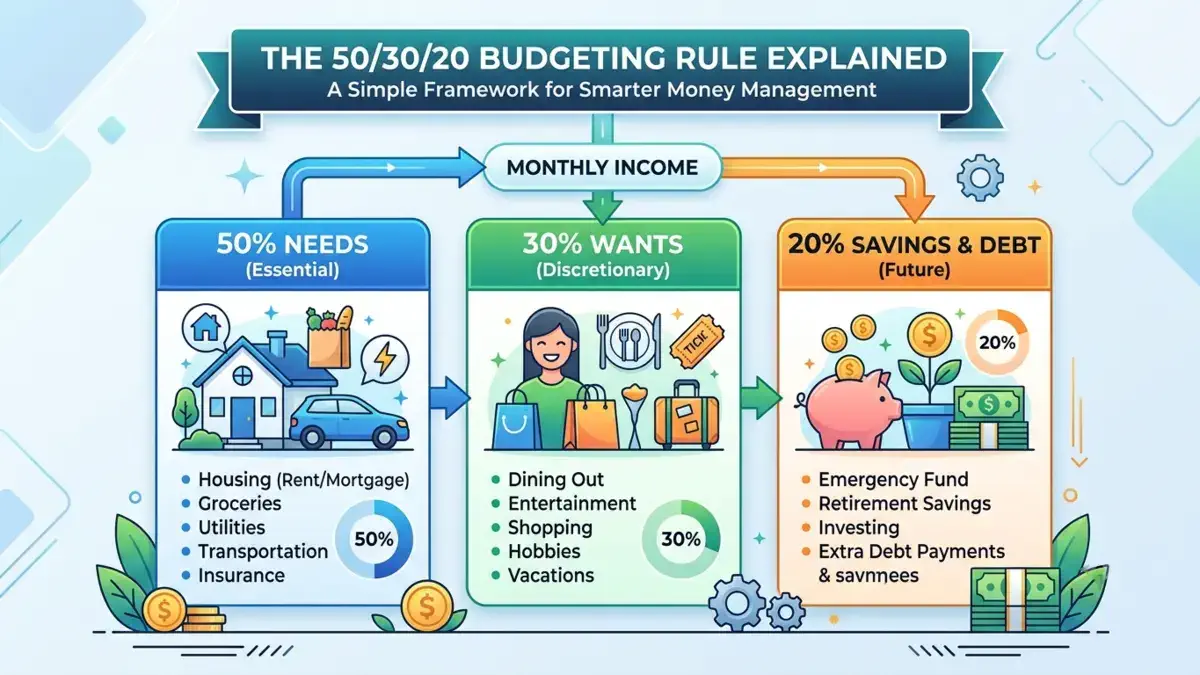
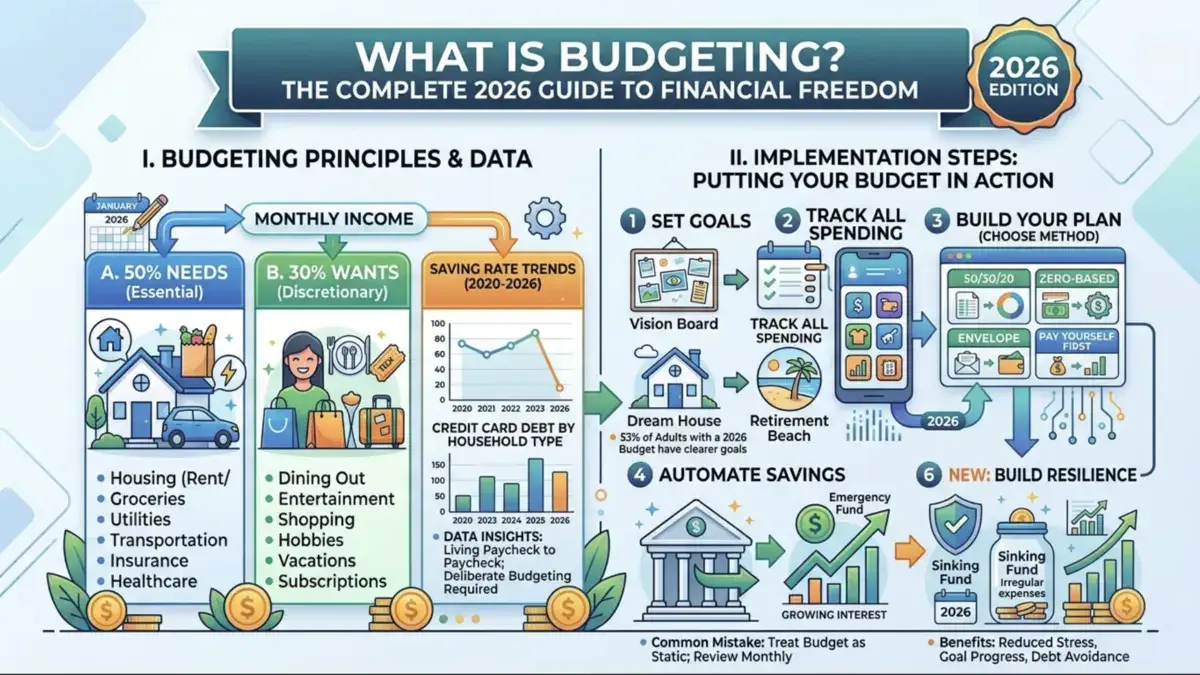
Preparing a bare-bones budget that covers only essentials — food, housing, transportation, insurance, and minimum debt payments — before a recession arrives gives you an immediate action plan if income drops. Knowing exactly where you can cut — and what you will never cut — removes the panic-driven decision-making that typically leads to the worst financial outcomes during downturns.
Maintain a Strong Credit Score
A credit score of 740 or above provides the best access to loan products during a recession — which matters because lower interest rates during downturns only benefit those who qualify for them. Protecting your credit score in the months leading into an economic slowdown ensures you can refinance debt, access emergency credit, or qualify for a mortgage if home prices fall to attractive levels.
Conclusion: Recessions Are Temporary — Financial Preparedness Is Permanent
Every recession in U.S. history has ended. Every economic expansion that followed has eventually surpassed the pre-recession peak in employment, output, and household wealth. This long-run pattern doesn’t make recessions painless — for households that enter them unprepared, with high debt, thin savings, and no income diversity, the damage can linger for years. But for households with a solid financial foundation, a recession is an economic disruption they can weather — and in some dimensions, an opportunity they can capitalize on.
You cannot control when a recession arrives, but you can control how ready you are. Every preparation step strengthens your finances in good times too — so there is nothing to lose by preparing now.
Ready to recession-proof your finances? Start by calculating your bare-bones monthly expenses, setting a six-to-twelve-month emergency fund target, and auditing your current debt obligations. Taking even one of these steps this month puts you meaningfully ahead of the financial vulnerability that makes recessions so damaging for unprepared households.