Introduction: Three Digits That Shape Your Entire Financial Life
Could three numbers determine whether you can rent an apartment, buy a car, qualify for a mortgage, or even land a job? In the United States, they can. Your credit score — a three-digit figure ranging from 300 to 850 — is one of the most consequential numbers in your financial life, yet most Americans have only a vague understanding of how it is calculated or what genuinely moves it.
According to FICO’s Spring 2026 Credit Insights Report, the average U.S. FICO Score has declined to 714, continuing a gradual downward trend since 2023, driven primarily by resumed student loan delinquency reporting and a modest increase in mortgage delinquencies. While 714 sits comfortably in the “Good” range, it also means that a significant share of American borrowers are leaving thousands of dollars on the table — in the form of higher interest rates, steeper loan fees, and less favorable terms — simply because they don’t fully understand what drives this number.
This guide explains exactly what a credit score is, how it is calculated, what the ranges mean in real financial terms, and the most effective strategies to build or improve yours in 2026.
What Is a Credit Score?
A credit score is a numerical summary of your creditworthiness — a snapshot of how reliably you have managed borrowed money in the past and, by statistical extension, how likely you are to repay future obligations. Lenders, landlords, insurers, and even some employers use this three-digit figure to evaluate risk before extending credit, setting interest rates, or granting access to financial products.
Scores are generated by mathematical models that analyze the data in your credit report — a detailed record maintained by the three major credit bureaus: Equifax, Experian, and TransUnion. Because each bureau may hold slightly different information, your score can vary marginally depending on which bureau a lender pulls from and which scoring model they use.
FICO Score vs. VantageScore: The Two Models You Need to Know
Two scoring systems dominate the U.S. credit landscape:
FICO Score
Developed by Fair Isaac Corporation, the FICO Score is the most widely used credit scoring model in lending decisions. The average FICO credit score in America is 714 as of March 2026, while the average VantageScore is 701 — both falling in the “Good” range. FICO requires at least six months of credit history and at least one account reported within the past six months to generate a score.
VantageScore
Developed jointly by the three major credit bureaus, VantageScore 4.0 can score consumers with as little as one month of credit history, making it especially useful for people newer to credit. VantageScore also goes further by factoring in on-time rent and utility payments, which can help renters with thin credit files who have never had a mortgage or auto loan.
Both models use the same 300–850 scale. For most major lending decisions — particularly mortgages and auto loans — lenders rely primarily on FICO scores.
Credit Score Ranges: What Each Tier Means
Understanding where your score falls — and what it means in practical terms — is the foundation of credit management.
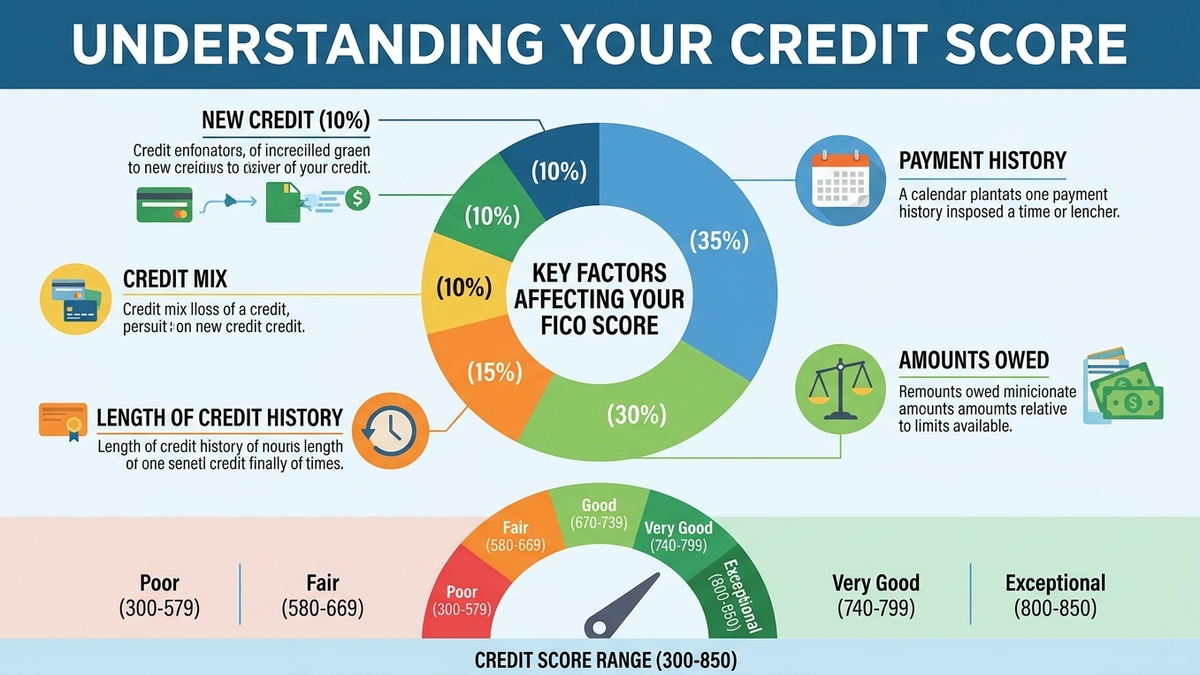
| FICO Score Range | Tier | What It Means |
|---|---|---|
| 800 – 850 | Exceptional | Best available rates; preferred borrower status |
| 740 – 799 | Very Good | Access to competitive rates on most products |
| 670 – 739 | Good | Qualifies for most standard credit products |
| 580 – 669 | Fair | Higher rates; limited product access |
| 300 – 579 | Poor | Significant barriers to approval; secured products only |
A record 48.1% of U.S. consumers now have FICO scores of 750 or higher, up from 43.3% in 2019, even as the national average has edged downward. This growing split between a well-scored top tier and a struggling lower tier reflects a widening gap in credit health across American households.
About 70% of Americans carry a FICO score of 670 or higher, placing them in the “Good” category or above, while 16.3% of Americans carry scores below 600, placing them in the “Very Poor” tier.
How Is a Credit Score Calculated? The 5 FICO Factors Explained
Your FICO credit score is calculated from five factors: payment history (35%), credit utilization (30%), length of credit history (15%), credit mix (10%), and new credit inquiries (10%). Payment history and utilization together account for 65% of the score and are the two factors most worth optimizing.
1. Payment History — 35%
This is the single most important factor in your FICO score. It measures whether you have paid your past accounts on time, and it encompasses on-time payments, late payments of 30 days or more, defaults, charge-offs, and collections activity. A single 30-day late payment can drop a high score by 100 points or more and remains on your credit report for seven years.
The practical implication is clear: no other credit action delivers as much long-term damage as a missed payment, and no other habit delivers as much long-term benefit as consistent, on-time payment across all accounts.
2. Credit Utilization (Amounts Owed) — 30%
Credit utilization is the percentage of available revolving credit — mainly credit cards — that is currently reported as in use. It is calculated as reported balance divided by reported credit limit, multiplied by 100.
Under 30% is a baseline threshold; under 10% is considered ideal for maximizing this portion of your score. Crucially, paying down revolving balances before the statement closes can lift the score within one billing cycle — making utilization reduction the fastest lever available for a meaningful near-term score increase.
3. Length of Credit History — 15%
This factor rewards longer, well-managed credit relationships. It considers how long your oldest account has been open, the average age of all your accounts, and how recently each account has been used. This is why closing old credit card accounts — even ones you no longer use — can unintentionally lower your score by shortening your average account age.
4. Credit Mix — 10%
Lenders prefer to see that you can responsibly manage multiple types of credit — a combination of revolving accounts (credit cards) and installment accounts (auto loans, mortgages, student loans). A diverse credit profile signals broader financial competence. However, this factor carries relatively little weight, and you should never take on unnecessary debt just to improve your credit mix.
5. New Credit (Hard Inquiries) — 10%
Each time you formally apply for new credit, the lender performs a “hard inquiry” on your credit report, which can temporarily lower your score by a small number of points. You no longer need to pay to check your own FICO Score — Discover, Experian, American Express, Capital One, and most major card issuers now offer it for free. Checking your own score is a “soft inquiry” and never affects your credit score.
Why Your Credit Score Matters: The Real Dollar Cost
The financial stakes of your credit score are most visible in mortgage lending — where the difference between a good and an excellent score can cost tens of thousands of dollars over the life of a loan.
The difference between a fair credit score and an exceptional one can cost more than $56,000 over the life of a $300,000 mortgage. Improving from a 620 to a 760+ score saves approximately $156 per month and $56,103 in total interest on a 30-year fixed loan.
The difference becomes even sharper when examining specific rate tiers:
- As of early 2026, a FICO score of 800 earns an APR of approximately 6.41% on a 30-year fixed mortgage, while borrowers with scores in the 620–639 range may face rates exceeding 8 percent on the same loan product.
- Mortgage industry data shows borrowers with 760+ credit paying around 7.24% APR, while those in the 700–759 range averaged about 7.45% — roughly a 0.20% difference for a 60-point score gap. Over a $400,000 loan, that’s roughly $165 more per month, or about $59,000 in additional interest over 30 years.
The impact extends well beyond mortgages. Your credit score also influences the APR you are offered on auto loans and credit cards, whether a landlord approves your rental application, the deposit amount a utility company may require, and in some states, even your auto insurance premium.
Credit Score by Generation: How Age Shapes Your Score
Credit scores tend to rise with age — not because older people are inherently more financially responsible, but because they have had more time to build the length of credit history and payment track record that scoring models reward.
The median FICO Score in the U.S. currently stands at 744, meaningfully above the 714 average, reflecting the influence of high-scoring older borrowers pulling the median upward. Younger consumers — particularly Gen Z and younger Millennials — typically carry lower scores not from poor financial management, but simply from shorter credit histories and thinner credit files.
This also explains why establishing credit early — through a secured credit card, a credit-builder loan, or becoming an authorized user on a parent’s account — carries compounding benefits over time, as the length-of-history factor grows more valuable with each passing year.
Practical Strategies to Build or Improve Your Credit Score
Pay Every Bill on Time — Without Exception
Because payment history accounts for 35% of your FICO score, consistent on-time payments are the single most powerful long-term strategy. Set up autopay for at least the minimum payment on every account to eliminate the risk of accidentally missing payments.
Reduce Credit Card Balances Before Statements Close
Since utilization is calculated on reported balances — not the balance at month-end — paying down credit card balances before your statement closing date reduces the utilization figure reported to the bureaus. This can produce a measurable score improvement within a single billing cycle.
Keep Old Accounts Open
Unless an account carries a high annual fee that outweighs its benefits, keeping older accounts open preserves your average account age and maintains your total available credit limit, both of which support your score.
Limit Hard Inquiries
Avoid applying for multiple new credit accounts within a short period. When shopping for a mortgage or auto loan, multiple inquiries from the same type of lender within a 14–45 day window are typically counted as a single inquiry by FICO, allowing rate shopping without score penalty.
Check Your Credit Reports Regularly for Errors
Credit score disparities across racial and ethnic groups in America are large, persistent, and well-documented, and errors on credit reports — which are more common than most consumers realize — can unfairly suppress scores. Under federal law, you are entitled to one free credit report from each of the three major bureaus annually through AnnualCreditReport.com. Disputing inaccuracies promptly can result in meaningful score improvements.
Conclusion: Your Credit Score Is Built One Decision at a Time
A credit score is not a fixed judgment — it is a living reflection of ongoing financial behavior, recalculated with every new piece of data your lenders report to the credit bureaus. Even as the national average FICO Score has dipped to 714, a record 48.1% of U.S. consumers now score 750 or higher — evidence that deliberate, consistent credit management can move anyone up the scale over time.
The mathematics are straightforward: pay on time, keep utilization low, maintain older accounts, and limit unnecessary new credit applications. These four behaviors alone address 65% of the FICO scoring model and form the foundation of credit health at every income level and every starting point.
Ready to take action on your credit score? Pull your free credit report today at AnnualCreditReport.com, check your current score through your bank or card issuer’s free tool, and identify the one factor — whether a high utilization ratio or a history of late payments — that you can begin addressing this month.